
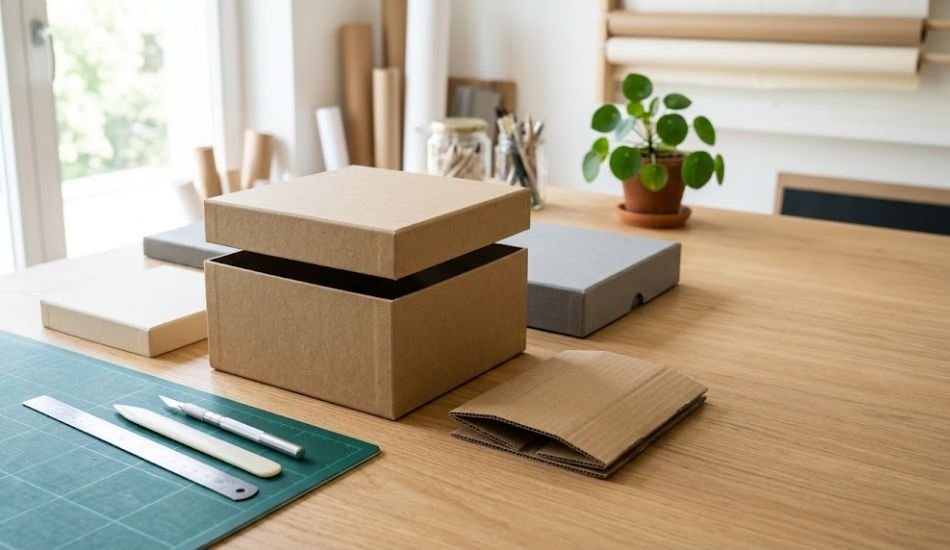
Most of us handle a Pappedeckel every week without noticing it. It is the lid on a gift box, the cover of an archive box, the top of a shoebox, or the flap you fold over a takeaway container. It rarely gets attention, yet it decides whether a box stays closed, whether the contents stay protected, and whether the whole package feels considered or cheap.
This guide explains what a Pappedeckel is, which materials and lid styles exist, and where each one works best. It also covers how to choose one, how to deal with it sustainably, and how to make a simple one at home.
What Is a Pappedeckel?
The word combines “Pappe” (cardboard or paperboard) and “Deckel” (lid). A Pappedeckel is therefore any lid or cover made from cardboard, whether it is a separate piece that sits on a box or a hinged flap that is part of the box itself. You will also see the terms Pappdeckel or Kartondeckel, which mean roughly the same thing in everyday German.
What makes it useful is a mix of properties. Cardboard is light, cheap to produce, easy to print on, and simple to cut into almost any shape. Compared with plastic or metal lids, a Pappedeckel is also easy to customise for small runs, which is why it turns up so often in gift packaging, product boxes, and craft projects.
It also helps to separate the lid from the closure. A lid covers the opening, while a closure, such as tape, a sticker, a ribbon, or a tuck-in tab, keeps it shut. Some designs combine both, but many separate lids rely on a snug fit alone. That difference matters when you choose a design later on.
Materials and Lid Styles
Common cardboard types
Not all cardboard behaves the same way, and the material has a large effect on how a Pappedeckel performs. Corrugated board, the wavy-layered material used in shipping cartons, is strong and cushions impact well. Solid board, often sold in Germany as Vollpappe, is dense and smooth, which makes it popular for rigid gift boxes and premium packaging. Greyboard (Graupappe) is a firm, economical option often used for archive boxes, book covers, and craft work.
Thinner folding carton is common for lightweight lids such as those on cosmetics or small food boxes. Surface treatments vary too. Uncoated kraft board has a natural, earthy look, while coated or laminated versions resist moisture and scuffing better but can be harder to recycle.
Popular lid designs
The design of the Pappedeckel matters as much as the material. A telescope lid (Stülpdeckel) is a separate top that slides over the base and is the classic style for shoeboxes and gift boxes. A hinged lid is attached along one edge and flips open. A tuck-in lid folds into the box body with a small flap and needs no glue or tape.
Some lids are shallow and only cover the top, while others are deep and overlap the sides by several centimetres. Deeper lids usually close more securely and look more polished, but they use more material. Shallow lids suit lightweight items and tidy stacking.
Strength and moisture
Cardboard has real limits. It weakens when damp, so a Pappedeckel is a poor choice for wet environments unless it has a protective coating. It also sags under heavy stacking loads if the board is too thin. If you plan to stack boxes, choose a sturdier board or a lid with reinforced edges rather than hoping for the best.
Where a Pappedeckel Is Used
Packaging and shipping
In shipping, the lid is often part of a single die-cut carton that folds together, protecting the goods and keeping costs low. Separate lids appear more in retail packaging, where presentation matters. A neat Pappedeckel on a product box signals care, and a well-fitted one gives that satisfying moment when the lid lifts slowly instead of popping off.
Small businesses like these lids because they can be printed with a brand pattern or a simple stamp without much investment. Even a plain kraft lid with a hand-written label can look intentional and personal.
Storage and archiving
At home and in offices, the Pappedeckel is the workhorse of storage. Document boxes, photo boxes, and craft organisers all rely on it. For long-term storage of important papers or photographs, look for boxes described as acid-free or archival, since ordinary cardboard can degrade over many years and affect what is stored inside. This is general conservation advice, and specialised archives may have their own standards.
Keep storage boxes off damp floors and away from heat sources. A lid that fits well also helps keep out dust, which is often the real enemy of stored paper.
Food and hygiene considerations
Cardboard lids are common on pizza boxes, bakery boxes, and takeaway containers. Anything intended to touch food should be made from materials suitable for food contact. In the EU, packaging materials of this kind fall under the general framework of Regulation (EC) No 1935/2004, which requires that they do not transfer harmful substances to food. If you buy food packaging commercially, ask the supplier whether it is designated for food contact rather than assuming any cardboard will do.
Grease can also soak through plain board, so greasy foods often need a liner or a coated lid. Do not reuse a food-stained Pappedeckel for storing clean food.
How to Choose the Right Pappedeckel
Measure first
The most common mistake is buying or cutting a lid that is the wrong size. A telescope lid must be slightly larger than the base so it slides on smoothly, but not so loose that it wobbles. In practice, a gap of a couple of millimetres on each side is a typical starting point, though the right tolerance depends on the board thickness. Always measure the outer dimensions of the base, not the inner ones, and test with a sample if you are ordering in bulk.
Match the board to the job
Think about weight, moisture, and how often the box will be opened. A gift box opened once can use thin, attractive board. A storage box opened weekly needs a sturdier Pappedeckel with reinforced corners, or the edges will fray. If the box will travel by post, remember that the lid should stay closed under vibration, so a snug fit or a tape closure is worth the extra step.
Consider finish and cost
Printing, embossing, foil, and coatings all raise the price and can change recyclability. For most everyday uses, a plain uncoated board is the practical and lower-impact choice. Save the decorative finishes for cases where presentation truly matters.
Sustainability and Disposal
Recycling basics
Plain cardboard is generally easy to recycle. In Germany, uncontaminated paper and board normally goes into the paper bin (blaue Tonne), and many other countries have similar systems. Local rules differ, so check what your area accepts. Flatten the lid before disposal to save space and keep it dry, since wet or greasy cardboard can spoil a whole batch of recyclable paper.
Coatings and mixed materials
Plastic laminates, metallic foils, and wax coatings can make a Pappedeckel harder to recycle, because the layers must be separated. If a lid is heavily coated, your local guidance may tell you to treat it as general waste. When you have a choice, plain board with water-based printing is usually the simpler option to recycle, though the details depend on local facilities.
Reuse before recycling
Recycling is good, but reuse is usually better. Lids can become drawer dividers, plant-pot saucers for dry decorative use, craft backing, or protective corners for framed artwork. Keeping a few sturdy lids in a craft drawer often saves a purchase later.
Making a Simple Pappedeckel Yourself
What you need
A basic DIY lid needs cardboard or greyboard, a ruler, a pencil, a craft knife or strong scissors, a cutting mat, and glue or strong double-sided tape. A bone folder or the back of a spoon helps to score clean folds.
Step-by-step outline
Measure the outer length and width of your box base and add a small allowance for a smooth fit. Draw a rectangle for the lid top, then add a border on each side equal to the lid depth you want. Cut out the corners of the border so the sides can fold upward, score along the fold lines, and fold. Glue the corner tabs to the inside and press firmly until the glue sets.
Tips for a neat result
Cut slowly and with a fresh blade, because a dull blade tears cardboard rather than slicing it. Always cut on a mat, away from your hands, and keep fingers behind the ruler. Test the fit before the glue dries fully, so small corrections are still possible. Your first lid may not be perfect, and that is normal.
Frequently Asked Questions
What does Pappedeckel mean?
It is the German word for a cardboard lid or cover. It describes any lid made from paperboard or cardboard, from gift box tops to archive box covers.
Is a Pappedeckel suitable for food?
Only if it is made from materials designated for food contact and is clean and dry. Commercial food packaging in the EU is expected to comply with food contact rules, so check with the supplier. Avoid reusing lids that carried greasy or wet food.
Can I recycle a Pappedeckel?
Plain, clean cardboard is generally recyclable in paper collection systems. Coated, laminated, or greasy lids may not be accepted, so follow your local waste guidance.
How do I make sure a lid fits properly?
Measure the outer dimensions of the base and allow a small tolerance so the lid slides on without wobbling. Testing with a sample before making many is the safest approach.
Which board is best for heavy or stacked boxes?
Sturdier options such as thicker solid board or corrugated board generally hold up better than thin folding carton. Reinforced edges and a well-fitted lid help too, but always test with your actual load.
Conclusion
A Pappedeckel may look like a small detail, but it does real work. It protects contents, shapes the first impression, and affects how easy a box is to store, ship, and recycle. Understanding the basic materials and lid styles makes it much easier to choose sensibly.
When in doubt, start with the purpose. Decide whether the box is for shipping, storage, gifting, or food, then match the board, fit, and finish to that job. Measuring carefully and avoiding unnecessary coatings will save both money and frustration.
Whether you buy a ready-made Pappedeckel or cut your own, keep sustainability in mind. Choose plain board where you can, reuse lids before discarding them, and recycle clean cardboard according to local rules. That way this humble piece of packaging stays useful for as long as possible.
For more useful explanations, meanings, and informative articles, keep visiting Newzispaper for fresh and easy-to-understand content.