
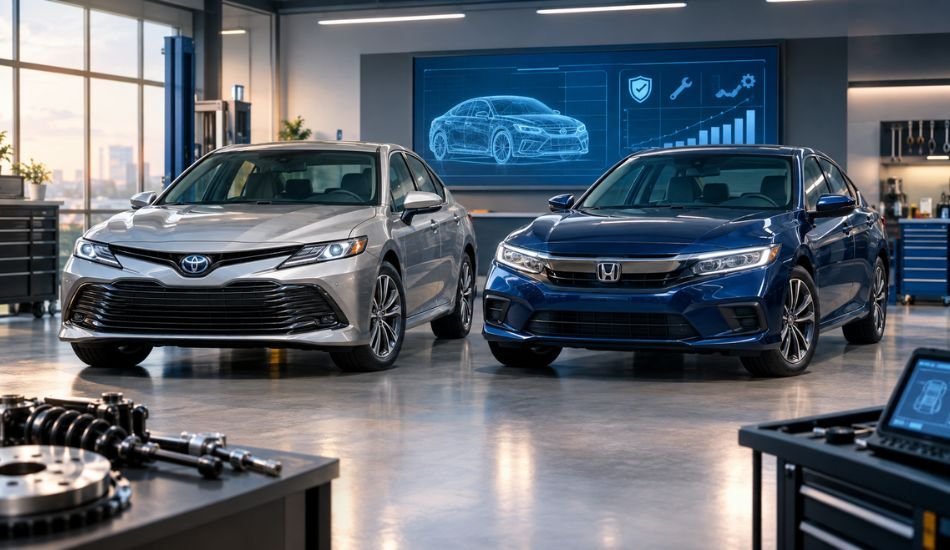
If you’ve been car shopping lately, chances are you’ve landed on the same debate that’s been running in driveways and dealership lots for decades: Toyota vs Honda reliability. Both brands have built rock-solid reputations for building cars that keep going well past the 100,000-mile mark, and both show up near the top of nearly every dependability survey out there. But when you actually dig into the details — engine longevity, transmission issues, maintenance costs, and how each brand ages over a decade or more — some real differences start to emerge.
This guide breaks down what actually separates these two automakers, where each one tends to shine, and what you should weigh before deciding which one deserves your money. We’ll keep things practical rather than just repeating brand slogans, because at the end of the day, reliability is about real-world ownership experience, not marketing copy.
Why Toyota and Honda Are Both Considered Reliability Leaders
Toyota and Honda didn’t earn their reputations overnight. Both companies built their names in the 1970s and 80s by offering fuel-efficient, well-engineered vehicles at a time when many competitors were struggling with quality control. That early reputation stuck, and both brands have spent the decades since reinforcing it through consistent engineering philosophies rather than flashy redesigns every year.
A big part of why these two brands keep showing up together in reliability conversations comes down to their approach to innovation. Neither company tends to rush unproven technology into their most popular models. Toyota, in particular, is known for a conservative engineering style — new features and mechanical changes are often tested extensively in lower-stakes applications before making their way into best-sellers like the Camry or Corolla. Honda has historically taken a similar approach, though it has occasionally been a bit more willing to experiment with things like turbocharged engines and continuously variable transmissions (CVTs) earlier than Toyota did.
Toyota vs Honda Reliability It’s also worth noting that reliability perception isn’t just about the cars themselves — it’s about parts availability, dealer network quality, and how affordable repairs tend to be. Both Toyota and Honda have widespread service networks and a strong aftermarket parts ecosystem, which means even out-of-warranty repairs are usually less painful on the wallet than they’d be with a luxury brand or a manufacturer with a smaller footprint. This combination of engineering discipline and practical ownership costs is exactly why both brands consistently land near the top of long-term dependability studies.
Engine and Powertrain Comparison
When people talk about Toyota vs Honda reliability, engines are usually where the conversation starts. Toyota’s naturally aspirated four-cylinder and V6 engines have a long track record of running well past 200,000 miles with basic maintenance. Models like the 2GR-FE V6 and the older 1NZ-FE and 2AZ-FE four-cylinders (despite a well-documented oil consumption issue in some model years) are frequently cited by mechanics as engines that simply refuse to quit if you keep up with oil changes and coolant flushes.
Honda’s engines have earned similar praise, especially the K-series four-cylinders used in the Civic and Accord. These engines are known for being both efficient and remarkably durable, and Honda’s naturally aspirated units in particular have a reputation for smoothness and low long-term maintenance needs. Where things get more nuanced is with Honda’s transmissions. Some Honda models from the mid-2000s through the early 2010s had automatic transmission problems, particularly in V6 Accords and Odysseys, which is a black mark that still comes up in reliability discussions today.
Toyota vs Honda Reliability hasn’t been entirely immune to transmission issues either — some of its earlier CVTs and certain six-speed automatics have had their own hiccups — but on balance, independent mechanics and long-term owner surveys tend to rate Toyota’s transmission durability slightly ahead of Honda’s, especially in models built before 2015. More recent generations from both brands have significantly ironed out these issues, so if you’re looking at anything from roughly 2018 onward, the transmission gap between the two brands has narrowed considerably.
Long-Term Ownership Costs and Maintenance
Reliability isn’t just about whether a car breaks down — it’s also about how much it costs to keep running smoothly year after year. Both Toyota and Honda are known for relatively low annual maintenance costs compared to the industry average, largely because their parts are affordable and widely stocked, and because independent mechanics are comfortable working on them without needing specialized dealer tools.
That said, there are some differences worth knowing. Toyota vehicles, especially trucks like the Tacoma and Tundra, are famous for extremely low depreciation and strong resale value, which is partly a reflection of how confident buyers are in long-term durability. Owners often report driving Toyota trucks and SUVs for 15-20 years with only routine maintenance, and it’s not unusual to see high-mileage Land Cruisers or 4Runners still running strong well past 250,000 miles.
Honda, meanwhile, tends to have a slight edge in fuel efficiency across comparable segments, and its sedans and compact cars — the Civic and Accord especially — are often cited as having lower routine maintenance costs than their Toyota counterparts (the Corolla and Camry) over the first 100,000 miles. However, once vehicles pass the 150,000-mile mark, some owners and mechanics report that Toyota models tend to need fewer major repairs, particularly around suspension components and electrical systems. Neither brand is dramatically more expensive to own than the other, but the specific model and its history of common issues matter more than the badge on the hood.
Which Brand Wins in Real-World Reliability Surveys?
Consumer Reports, J.D. Power, and various long-term owner surveys have consistently ranked both brands near the top of the industry, and the gap between them tends to be small enough that it often comes down to specific models rather than brand-wide generalizations. Toyota has generally held a slight statistical edge in overall brand reliability rankings over the past decade, partly thanks to strong performances from the Corolla, Camry, RAV4, and Tacoma across multiple model years.
Honda, on the other hand, has had a few rougher patches — particularly around 2008-2015 model years, when certain V6 engines and transmissions drew more complaints. Since then, Honda has made noticeable improvements, and current-generation Civics, Accords, and CR-Vs are once again scoring very well in dependability studies. It’s a good reminder that reliability isn’t static — a brand’s reputation reflects an average across many years, but individual model generations can vary quite a bit.
It’s also worth remembering that these rankings are based on aggregated survey data and reported problems, not guarantees about any individual vehicle. A well-maintained Honda can easily outlast a neglected Toyota, and vice versa. If you’re comparing specific models, it’s worth looking up reliability ratings for that exact year and trim rather than relying purely on brand reputation.
Which One Should You Choose?
If your priority is maximum long-term durability with minimal fuss — especially in trucks, SUVs, or vehicles you plan to keep for 15+ years — Toyota has historically had a slight advantage, particularly with its trucks and hybrid powertrains, which have built an excellent reputation for battery and engine longevity. Toyota’s hybrid system, used in the Prius and Camry Hybrid for example, has proven remarkably durable over hundreds of thousands of miles, which is a meaningful point in its favor if you’re considering a hybrid.
If you value a slightly sportier driving feel, strong fuel economy, and excellent reliability in sedans and compact cars, Honda remains an outstanding choice. The Civic and Accord in particular have loyal followings precisely because they balance efficiency, comfort, and dependability so well. For most everyday drivers, either brand will likely serve you reliably for well over a decade if properly maintained.
Ultimately, the Toyota vs Honda Reliability debate often comes down to which specific model fits your needs, budget, and driving style — both automakers have earned their reputations through genuinely solid engineering, and you’re unlikely to go wrong with either, provided you do your homework on the specific year and model you’re considering.
Frequently Asked Questions
1. Is Toyota more reliable than Honda overall? On average, Toyota has scored slightly higher in broad reliability surveys over the past decade, but the difference is often small and varies by specific model and model year. Both brands are considered among the most dependable in the industry.
2. Which lasts longer, a Toyota or a Honda engine? Both brands produce engines known to exceed 200,000 miles with proper maintenance. Toyota’s naturally aspirated engines have a particularly strong reputation for longevity, while Honda’s K-series engines are also widely praised for durability.
3. Do Hondas have more transmission problems than Toyotas? Some Honda models from the mid-2000s to early 2010s, especially V6 Accords and Odysseys, had documented automatic transmission issues. Toyota has had its own transmission hiccups in certain years, but overall has a slightly better track record in this specific area.
4. Which brand has cheaper long-term maintenance costs? Both brands are relatively affordable to maintain compared to the industry average. Honda sedans often have lower costs in the first 100,000 miles, while Toyoda models sometimes need fewer major repairs after 150,000 miles, though this varies by model.
5. Are Toyota vs Honda Reliability and Honda hybrids equally reliable? Toyota’s hybrid system has an especially strong long-term reliability record, with many Prius and Camry Hybrid owners reporting minimal battery or powertrain issues even past 200,000 miles. Honda’s hybrids are also solid, though Toyota’s hybrid technology has generally been on the market longer and has a slightly more extensive track record.
Conclusion
When it comes to Toyota vs Honda reliability, you’re really choosing between two of the most dependable automakers in the world. Toyota vs Honda Reliability tends to have a slight edge in overall longevity, especially in trucks, SUVs, and hybrids, while Honda holds its own with excellent engineering in sedans and compact cars, along with strong fuel efficiency. Rather than picking a side based on brand loyalty alone, it’s worth researching the specific model, model year, and known issues for the vehicle you’re considering — that’s ultimately a better predictor of how long your car will last than the badge on the grille.
Whether you choose Toyota vs Honda Reliability, regular maintenance and the right model can make a big difference in long-term reliability. For more useful automotive information and helpful comparisons, keep following NewsPaper.